Concrete Removal Services in Wilmington, NC: A Guide
Concrete removal in Wilmington NC often marks the moment a commercial property begins its next chapter. A cracked warehouse slab, a vacant retail building, an obsolete loading area, or a storm-damaged structure can keep a valuable site from moving forward. Removing those obstacles takes more than heavy equipment. It takes a plan that protects people, manages materials, coordinates utilities, and leaves the property ready for construction, redevelopment, or sale.
Commercial properties across Wilmington and the Cape Fear region are changing fast. Older buildings are being repurposed. Underused lots are becoming office space, retail centers, medical facilities, industrial sites, and mixed-use developments. Some properties need a complete teardown. Others need a targeted interior demolition, a foundation removed, a parking area broken up, or a building addition cleared away before the next phase can start.
Barnes Demolition handles commercial demolition with the final goal in view: a clean, safe, usable site. We work with property owners, developers, general contractors, facility managers, investors, and business owners throughout Wilmington, Leland, Hampstead, Jacksonville, Holly Ridge, Rocky Point, Currie, and the surrounding coastal North Carolina area.
Our crews take on full commercial demolition, partial demolition, interior demolition, concrete and foundation removal, debris hauling, land clearing, and grading. From the first walkthrough through final cleanup, we focus on the work that turns an aging property into a place with a future.
Commercial Demolition Is About More Than Tearing Down a Building
A commercial demolition project may look simple from the road. Equipment arrives. The building comes down. Trucks haul away debris. But the real work begins well before the first wall is removed.
Every structure has a history. A commercial building may have received additions over decades. It may sit on thick concrete footings, contain old utility lines, rest beside an active business, or occupy a tight lot with limited equipment access. Its site may include old pavement, buried debris, retaining walls, abandoned equipment pads, drainage structures, and overgrown areas that complicate redevelopment.
That is why commercial demolition needs a broader view. The goal is not merely to remove a structure. The goal is to prepare the property for its next purpose.
Barnes Demolition approaches every job by studying the entire site. We look at the building, the concrete beneath it, access routes, adjacent structures, utilities, material-handling needs, site conditions, and the client’s plans after demolition is complete.
A clean commercial demolition project can include:
- Full removal of retail buildings, warehouses, office buildings, restaurants, industrial structures, and mixed-use properties
- Selective demolition for renovations, additions, remodels, and adaptive-reuse projects
- Interior demolition for commercial buildouts and tenant improvements
- Concrete slab, foundation, footing, curb, sidewalk, retaining-wall, and loading-pad removal
- Removal of detached structures, storage buildings, garages, canopies, sheds, docks, and outbuildings
- Site debris removal, land clearing, tree removal, brush clearing, and stump removal
- Grading and cleanup that prepare the property for construction or redevelopment
Concrete removal in Wilmington NC frequently becomes part of this larger process. A building can be gone while the site remains blocked by old foundations, reinforced slabs, broken pavement, or buried structural elements. Addressing those materials as part of the demolition plan prevents the next contractor from inheriting an incomplete site.
Why Commercial Demolition Requires a Clear Plan
Commercial demolition can affect schedules, budgets, construction sequencing, inspections, tenant operations, and the overall value of a property. A poor plan can leave owners with unexpected debris, utility problems, exposed concrete, or a site that still requires major work before construction can begin.
The right plan creates control. It identifies what needs to be removed, what needs to stay, who needs to be involved, and what the property should look like when the work ends.
Barnes Demolition develops each scope around the conditions on the ground. No two commercial sites are identical, even when the buildings look similar from the outside.
The Site Walkthrough Comes First
The first walkthrough gives us the information needed to plan the work properly. We assess the structural condition of the building, the location of visible utilities, nearby improvements, access points, traffic patterns, and the presence of exterior concrete or buried features.
During a site review, we consider questions such as:
- Does the project require full building demolition or only partial removal?
- Is the building vacant, occupied, or connected to an operating business?
- Which utilities must be disconnected, capped, relocated, or protected?
- Can trucks and excavators safely access the property?
- Are sidewalks, roads, neighboring buildings, fences, drainage features, or overhead lines close to the demolition zone?
- Does the project include foundations, footings, slabs, drive lanes, curbs, or retaining walls?
- What materials need special handling, recycling, hauling, or disposal?
- Does the property need rough grading or full site preparation after demolition?
- What construction, sale, or redevelopment work begins after our crews leave?
These details shape the demolition method and schedule. They also help prevent misunderstandings about what the project includes.
Concrete removal in Wilmington NC should be discussed during this first stage, not added as an afterthought. Old commercial slabs can extend beyond the visible building footprint. A former loading dock, drive-through lane, dumpster pad, patio, equipment platform, or parking area may contain concrete that affects the future layout of the property.
Commercial Sites Often Have Hidden Challenges
Older properties can hold surprises. A vacant building may have an unseen foundation beneath a later addition. An overgrown lot may conceal old pavement and demolition debris. A commercial slab may cover abandoned drains, utility lines, or thickened structural edges.
Coastal North Carolina conditions can also influence the work. Heavy rain, soft ground, drainage concerns, hurricane damage, and seasonal weather patterns all affect site access and scheduling. Equipment must be able to move safely, trucks need reliable haul routes, and demolition debris must be managed without creating unnecessary disruption for nearby properties.
Barnes Demolition evaluates these conditions before mobilizing equipment. That preparation helps us work safely and helps our clients avoid avoidable delays.
The Commercial Demolition Process
A professional demolition project follows a deliberate sequence. The order can vary by property, but the principle remains the same: prepare the site, control the demolition, manage the debris, and leave the property ready for the next stage.
Barnes Demolition manages projects from early coordination through final cleanup. We communicate with owners, general contractors, engineers, inspectors, utilities, and other parties involved in the job.
Defining the Scope of Work
Every project starts with a clear scope. We identify the building sections, structural elements, exterior improvements, and site materials that must be removed. We also confirm what must remain untouched.
For example, a redevelopment project may require the complete removal of a former restaurant and its parking lot. A renovation may require only the removal of a rear addition, interior walls, and an outdated concrete service area. A warehouse expansion may require selective demolition of one wall, a loading pad, and portions of existing pavement.
A detailed scope protects the project. It allows us to allocate the right equipment, schedule crews effectively, estimate hauling needs, and coordinate the work with other trades.
Permitting and Utility Coordination
Commercial demolition often requires permits, inspections, utility coordination, and communication with local authorities. Requirements vary according to the building, the project scope, the property location, and the jurisdiction.
Utilities must be handled before structural demolition begins. Electrical service, gas lines, water, sewer, communications lines, and other active connections can create major hazards if they remain active or are not properly identified.
Barnes Demolition coordinates with utility providers, permitting authorities, environmental agencies, and project teams as needed. That coordination keeps the work in the right sequence and reduces the chance of a costly interruption once demolition is underway.
Preparing the Jobsite
Before the demolition starts, the jobsite needs to be organized. Preparation may include setting work boundaries, establishing equipment routes, controlling site access, identifying protected areas, planning debris staging, and preparing for dust, noise, and runoff management.
On some commercial jobs, we also separate certain materials before the main demolition phase. That process depends on the type of building and the specific materials involved, but the objective is always the same: manage the demolition responsibly and avoid unnecessary problems later.
Preparation is particularly important in dense commercial areas of Wilmington. A building near an active roadway, occupied storefront, school, medical office, or residential neighborhood requires careful attention to site controls and equipment movement.
Structural Demolition
Once the site is ready, structural demolition can begin. Barnes Demolition uses excavators and specialized attachments to remove commercial structures in a controlled sequence.
The method depends on the building’s size, height, materials, condition, and location. A small single-story commercial structure may be removed quickly once utilities are disconnected and access is secured. A larger building, warehouse, industrial facility, or multi-phase redevelopment project may require a more structured process.
Our crews work through the building methodically. We manage falling material, keep work zones controlled, and protect areas that the client needs to preserve.
Commercial demolition often involves multiple materials at once:
- Wood framing and roof systems
- Brick, block, and masonry walls
- Structural steel and metal components
- Concrete foundations, slabs, and footings
- Mechanical equipment and interior fixtures
- Roofing materials and exterior cladding
- Pavement, sidewalks, curbs, and loading areas
Each material requires a practical removal and hauling plan. The work does not end when the main building falls. The site must be cleared of structural remnants, debris, and exterior features that interfere with the next phase.
Hauling, Recycling, and Cleanup
A demolition site can become difficult to manage if debris is allowed to build up without a plan. We keep material moving as the job progresses, using organized loading, hauling, sorting, recycling, and disposal practices.
Barnes Demolition works to recycle and responsibly dispose of demolition materials whenever possible. Concrete, metal, wood, masonry, and general debris do not all follow the same disposal path. Separating material helps keep the site cleaner and supports responsible management of demolition waste.
Our crews also focus on the practical condition of the property after removal. The site should not be left with scattered debris, exposed hazards, or unusable access routes. It should be ready for grading, utility work, construction, or the next agreed phase of redevelopment.
Concrete Removal for Commercial Redevelopment
Concrete removal in Wilmington NC is one of the most common needs on commercial demolition projects. Concrete lasts for decades, which is an advantage when it serves the current property. It becomes an obstacle when the building layout, drainage plan, traffic flow, or construction footprint changes.
Commercial concrete can appear in many forms:
- Building slabs and floor systems
- Perimeter foundations and footings
- Warehouse slabs and equipment pads
- Drive lanes and parking sections
- Sidewalks, curbs, and ramps
- Loading docks and loading pads
- Dumpster pads and service areas
- Retaining walls and site walls
- Outdoor patios, walkways, and entrance features
- Former drive-through lanes and vehicle circulation areas
Concrete removal in Wilmington NC calls for more than breaking material into smaller pieces. The crew must understand what lies around and beneath the concrete. Reinforcing steel, utility lines, drainage components, old septic infrastructure, thickened slab edges, and nearby structures can all influence how the work should proceed.
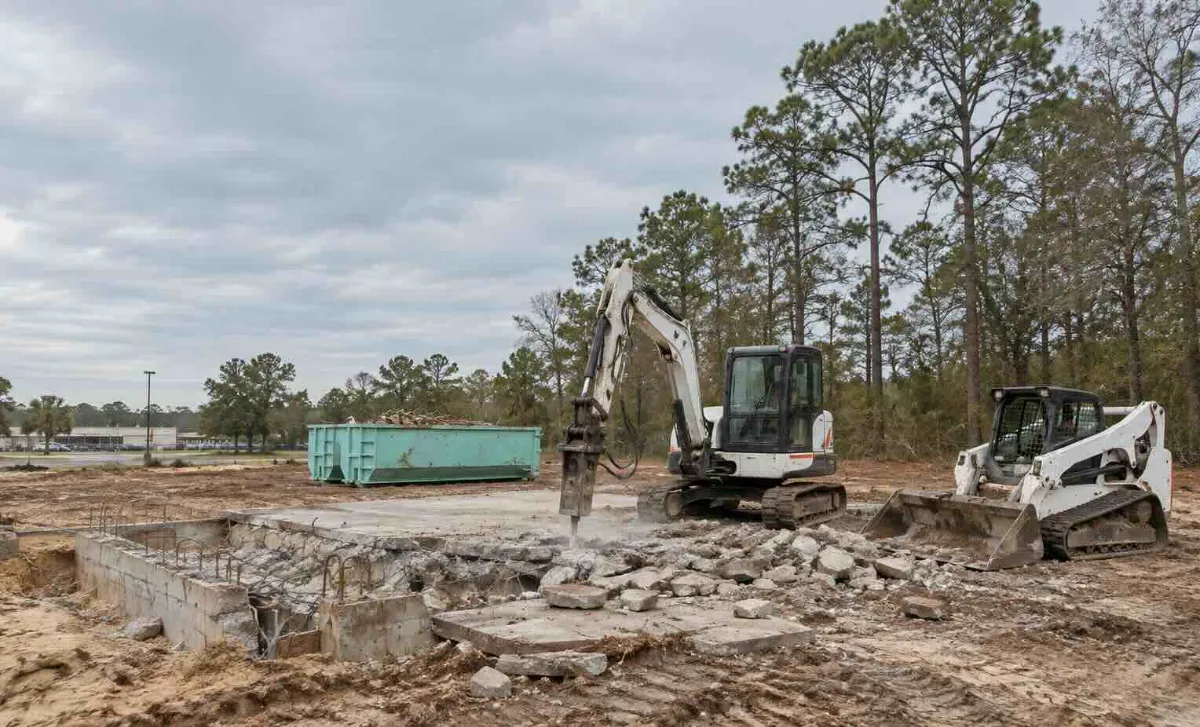
Barnes Demolition uses hydraulic breakers, excavators, and appropriate attachments to break up and remove concrete efficiently. We load and haul the material away, leaving the site ready for the next stage of work.
Removing Slabs and Foundations
A building demolition may leave a property with a slab, perimeter foundation, spread footings, or a combination of all three. Those concrete elements can interfere with new construction, utility installation, grading, drainage improvements, or future site design.
Concrete removal in Wilmington NC is often necessary when a property owner needs to:
- Build a structure with a new footprint
- Replace an old building with a larger or smaller facility
- Install new water, sewer, electrical, or drainage lines
- Correct settlement or drainage issues
- Create a clean commercial pad for redevelopment
- Remove unsafe or deteriorated concrete
- Prepare land for sale or a future tenant
- Eliminate old industrial or commercial site features
Foundation removal should be clearly defined in the project scope. Some owners want only the building removed. Others need all concrete below grade extracted, hauled away, and replaced with suitable material so the site can be graded for its next use.
We help clients determine which approach fits their goals. A property intended for sale may benefit from a clean, cleared lot. A future construction project may require complete foundation removal and rough grading. A renovation may require only selective concrete demolition around a new addition or utility route.
Parking Areas, Drive Lanes, and Exterior Improvements
Commercial sites often contain more concrete outside the building than inside it. A former retail property may have long sidewalks, loading areas, curbs, ramps, and vehicle lanes. A warehouse may have equipment pads, truck access areas, or reinforced service zones. An office complex may include sidewalks and site features that no longer match the future layout.
When concrete removal in Wilmington NC involves exterior improvements, we look at how those features connect to drainage, utilities, access, and planned construction. Removing one section without considering the surrounding site can create uneven grades, water-flow problems, or awkward transition points for the next contractor.
The best approach considers the whole property. If the goal is redevelopment, demolition should support the new site plan rather than simply remove the most visibly damaged concrete.
Why Commercial Concrete Needs the Right Equipment
Commercial concrete is not a light-duty material. Reinforced slabs, foundations, retaining walls, and equipment pads require controlled force and the proper machinery.
Barnes Demolition uses excavators and hydraulic breakers designed for concrete and foundation removal. This equipment lets our crews work efficiently while maintaining control around neighboring structures, utilities, and site features.
The process is especially important when crews must remove concrete close to an active building, within a confined commercial lot, or near areas that remain in use. In those situations, precision matters as much as power.
Selective Demolition for Commercial Renovations
Full demolition is not always the right answer. Many commercial buildings have a sound structure but an outdated layout, aging addition, abandoned service area, or interior configuration that no longer works.
Selective demolition removes specific elements while preserving the rest of the property. It is common in office remodels, retail updates, restaurant renovations, healthcare facilities, industrial upgrades, warehouse expansions, and commercial tenant buildouts.
Selective demolition can include:
- Interior walls and partitions
- Ceilings, flooring, fixtures, and built-in features
- Old service counters and storage areas
- Non-load-bearing walls and obsolete finishes
- Exterior additions and canopies
- Outdated entrance structures
- Portions of masonry or framing
- Equipment pads and small concrete areas
- Interior slab removal for plumbing or drainage work
The key to selective demolition is control. The crew must know what is coming out, what stays in place, and what needs protection throughout the process.
Barnes Demolition works closely with owners and general contractors to establish those limits before work begins. This is particularly important when part of a commercial building remains occupied or when a business needs to continue operating nearby.
Interior Demolition Without Unnecessary Disruption
Interior commercial demolition often takes place in buildings that are undergoing renovation rather than full replacement. The work may need to fit around building access, tenant schedules, deliveries, security requirements, or active operations.
A coordinated interior demolition plan can limit disruption by defining work areas, debris routes, equipment access, staging locations, and cleanup expectations. Communication keeps the job moving and helps everyone involved understand what will happen each day.
Barnes Demolition brings the same practical approach to interior demolition that we bring to larger teardown projects. We focus on safe removal, clean work areas, reliable hauling, and an organized handoff to the next trade.
Safety and Site Control Come First
Demolition involves heavy equipment, unstable materials, sharp debris, falling hazards, dust, traffic, utilities, and the potential for hidden site conditions. The work demands careful planning and trained crews.
Barnes Demolition follows strict OSHA safety protocols and uses trained, certified, and properly equipped crews. Safety measures protect the workers on site, but they also protect clients, neighboring businesses, pedestrians, adjacent structures, and the overall project schedule.
Protecting Adjacent Buildings and Businesses
Commercial demolition frequently happens near other businesses, public roads, sidewalks, residential neighborhoods, or occupied facilities. A demolition crew must work within defined boundaries and manage equipment movement carefully.
We assess issues such as:
- Distance from neighboring structures
- Property-line conditions
- Public sidewalks and roadways
- Vehicle traffic and delivery access
- Overhead power or communications lines
- Underground utilities and drainage structures
- Equipment entry and exit routes
- Dust, debris, and material containment
- Areas that must remain accessible during the work
The solution differs from site to site. A stand-alone warehouse on a large parcel gives crews room to work differently than a commercial building in a busy Wilmington corridor. We plan around the property’s real conditions rather than applying a generic demolition method.
Communication Supports Safe Work
Commercial demolition includes many moving parts. Owners, architects, engineers, lenders, inspectors, general contractors, utility companies, and tenants may all need updates during the project.
Barnes Demolition provides clear timelines, written estimates, and regular communication. We want clients to know what the work includes, when crews will be on site, and what condition the property will be in when the project is complete.
Strong communication also helps us respond to unexpected conditions. If crews uncover buried concrete, old utility lines, deteriorated structural components, or unanticipated debris, we address the issue directly and explain its impact on the scope and schedule.
Land Clearing and Grading After Commercial Demolition
Commercial demolition often leads directly into land clearing and grading. A building may be gone, but the property can still have brush, trees, stumps, debris, uneven ground, old pavement, or drainage concerns that prevent the next phase from starting.
Barnes Demolition provides land clearing, tree and stump removal, grading, debris hauling, and site preparation for commercial properties in the Wilmington area. Combining these services reduces the number of handoffs between contractors and keeps the project moving from teardown to build-ready conditions.
A vacant or overgrown commercial lot can hide potential. Thick vegetation can conceal old foundations, broken concrete, discarded materials, and uneven terrain. Clearing the property gives owners, engineers, and builders a more accurate picture of what is actually there.
From Overgrown Property to Build-Ready Ground
A neglected property can look like a liability, even when it sits in a strong commercial location. The first step toward making it usable is gaining safe access.
Our crews can clear brush, trees, stumps, debris, old structures, pavement remnants, and other obstructions. Once the site is open, it becomes easier to assess drainage, access, utilities, building areas, and the work required for redevelopment.
Concrete removal in Wilmington NC often connects directly to this process. A site may need an old slab removed before grading can begin. A former commercial building may leave behind hidden foundation remnants beneath brush or fill. An abandoned lot may contain broken sidewalks, service pads, and old drives that no longer fit the development plan.
Handling those tasks under one coordinated scope can save time and simplify scheduling.
Coastal Weather and Ground Conditions Matter
Wilmington and coastal North Carolina have site conditions that deserve attention. Rain, high groundwater, saturated soils, storm impacts, and drainage issues can affect equipment access and the timing of grading work.
We plan around the condition of the ground, not just the calendar. Equipment needs stable access, demolition debris needs defined haul routes, and final grading should support the property’s intended use.
The final condition may range from basic rough grading to a more carefully prepared site for construction. The level of work depends on the client’s plans, but the objective remains the same: create ground that helps the project move forward.
A Full-Service Approach to Commercial Demolition
Commercial clients often need more than a demolition crew. They need a partner who can handle the full scope of removal work without forcing them to coordinate multiple disconnected companies.
Barnes Demolition offers a full-service approach that includes permits, utility coordination, demolition, debris removal, concrete breaking, foundation removal, land clearing, and site preparation. The company serves commercial, residential, and industrial clients across Wilmington and the greater Cape Fear region.
That approach gives owners and contractors a clearer path from existing conditions to a clean site. It also helps ensure the work happens in the proper order.
For example, a commercial redevelopment project may begin with utility coordination and permit work. Crews can then remove an obsolete building, haul away structural debris, complete concrete removal in Wilmington NC, clear overgrowth from the rear of the parcel, and rough-grade the site for incoming construction crews.
Instead of managing a different contractor for every phase, the client has one demolition partner coordinating the work.
What a Finished Site Should Look Like
The right final condition depends on the property’s next use. A developer may need a fully cleared lot. A general contractor may need the foundation removed and a rough grade completed before construction begins. A commercial owner may need only a selective demolition area cleaned and prepared for a renovation crew.
Before work begins, we establish that final condition with the client. This prevents confusion over whether slabs remain, whether footings must come out, whether pavement stays in place, and whether the job includes grading or only demolition.
Barnes Demolition believes the project should finish with a site that makes the next step easier, not harder.
Serving Wilmington and the Cape Fear Region
Commercial development extends well beyond Wilmington city limits. Property owners and builders across Leland, Hampstead, Jacksonville, Holly Ridge, Rocky Point, Currie, and nearby communities face many of the same redevelopment challenges: outdated structures, aging concrete, overgrown lots, damaged buildings, and sites that need a fresh start.
Barnes Demolition serves these communities with the heavy equipment, local knowledge, and practical planning needed for jobs of different sizes. We handle everything from small commercial structures to multi-phase demolition and site-preparation projects.
Concrete removal in Wilmington NC remains a core service for local redevelopment, but our work reaches beyond a single slab or foundation. We look at how the removal supports the entire property plan, whether that plan involves rebuilding, expansion, sale, utility upgrades, or site restoration.
Choose a Contractor Built for the Job
Commercial demolition affects the timeline and cost of everything that follows. Choosing a contractor based only on the initial price can create problems if the scope is vague, equipment is inadequate, debris is not managed properly, or the crew lacks experience with complex commercial sites.
A qualified commercial demolition contractor should bring the right mix of planning, equipment, safety practices, and local experience.
When evaluating a demolition contractor, look for:
- Experience with commercial, industrial, and redevelopment projects
- Licensed, bonded, and insured operations
- A clear written scope and detailed estimate
- Ability to coordinate permits and utility disconnections
- Equipment suitable for structural demolition and concrete removal
- Debris hauling and responsible disposal capabilities
- Land clearing and grading services when the site requires them
- Strong safety practices and trained crews
- Clear project communication and reliable scheduling
- Familiarity with Wilmington-area conditions and logistics
Barnes Demolition brings more than 15 years of demolition experience to commercial, industrial, residential, concrete, land-clearing, grading, and septic-related projects throughout the Wilmington area.
We understand that commercial clients need direct answers. They need to know what the scope includes, what the equipment will do, how debris will be handled, what conditions may affect the schedule, and what the site will look like when the job is complete.
Build the Next Chapter on a Clean Site
A commercial demolition project is not an ending. It is the point where a property stops carrying the limitations of its past and starts making room for its future.
That future might involve a new retail space, office building, industrial facility, restaurant, medical practice, warehouse expansion, commercial pad, or investment property. It may start with a full building demolition, a partial teardown, land clearing, or concrete removal in Wilmington NC.
Barnes Demolition handles the difficult work that clears the path forward. We bring the equipment, planning, crews, and local experience needed to remove structures, slabs, foundations, pavement, debris, trees, and site obstacles safely and efficiently.
When your commercial property needs a clean slate, we are ready to help create it.
Frequently Asked Questions
What does commercial demolition include in Wilmington, NC?
Commercial demolition can include full building removal, selective demolition, interior demolition, structural teardown, debris hauling, concrete removal, foundation removal, land clearing, and grading. The exact scope depends on the building, property conditions, future plans, required permits, utilities, and whether any portion of the site must remain in service.
How often is concrete removal needed during commercial demolition?
Concrete removal in Wilmington NC is commonly needed when a building comes down and its slab, footings, foundation, loading area, sidewalk, curb, equipment pad, or parking features no longer fit the property’s future use. The work is especially important when new construction, utility installation, grading, or drainage improvements require a clear site.
Can Barnes Demolition remove a commercial building and the foundation beneath it?
Yes. Barnes Demolition can remove a commercial structure along with its concrete slab, foundation, footings, exterior pavement, and related debris. The scope can also include hauling, land clearing, and rough grading so the property is ready for construction, sale, or redevelopment.
How much does concrete removal in Wilmington, NC cost for a commercial property?
The cost of concrete removal in Wilmington NC depends on the amount of material, slab thickness, reinforcement, equipment access, hauling needs, utility conditions, disposal requirements, and whether the project includes foundations, grading, or building demolition. An on-site assessment provides the clearest estimate because commercial concrete often includes hidden footings or structural elements below ground.
How long does a commercial demolition project take?
The timeline depends on the size and condition of the structure, permit requirements, utility coordination, access, weather, material handling, concrete removal needs, and the condition required at completion. A small vacant building may move quickly, while a larger warehouse, industrial site, occupied property, or redevelopment project with extensive foundations can take longer.
Does Barnes Demolition provide land clearing and grading after demolition?
Yes. Barnes Demolition provides land clearing, tree and stump removal, debris hauling, grading, and site preparation after commercial demolition. Combining building removal, concrete removal in Wilmington NC, clearing, and grading under one coordinated scope can reduce delays and leave the property better prepared for its next use.